Serving Burnaby, BC

Spring safety for Burnaby homeowners

Why Do Garage Door Springs Break?

Garage door springs usually break after repeated cycles gradually fatigue the steel, although sizing, balance, installation and operating conditions can influence when failure occurs.

The direct answer

Spring Fatigue Builds One Cycle At A Time

A spring performs work every time the door opens and closes. It stores energy that helps counterbalance the door’s weight, then releases that energy through the lifting cycle. Repeated flexing eventually weakens the metal.

A break can seem sudden because the final separation happens at once, but the underlying fatigue usually developed over many cycles. That is why age alone is an incomplete measure: a busy household can place far more cycles on a spring than a lightly used garage.

Safe response: If you see a gap in a torsion spring, a loose extension spring or an unexpectedly heavy door, stop operating the system and arrange professional diagnosis.
Common contributors

What Can Shorten A Spring’s Working Life?

High Cycle Use

Using the garage as the main household entrance increases the number of daily lifting cycles and advances normal fatigue.

Incorrect Spring Sizing

A spring must match the door’s actual weight and geometry. An unsuitable spring can leave the door poorly balanced.

Door Weight Changes

Added insulation, reinforcement, glass or replacement sections can change the load the counterbalance system must support.

Corrosion And Contamination

Moisture and surface corrosion may contribute to deterioration. Burnaby’s wet seasons make visual inspection worthwhile.

Installation Problems

Incorrect setup, mismatched springs or poor alignment can place abnormal demands on the spring and related hardware.

Binding Door Hardware

Damaged rollers, hinges or tracks can increase resistance. The complete door should be assessed rather than treating the spring in isolation.

A visible torsion-spring clue

What Does A Broken Spring Look Like?

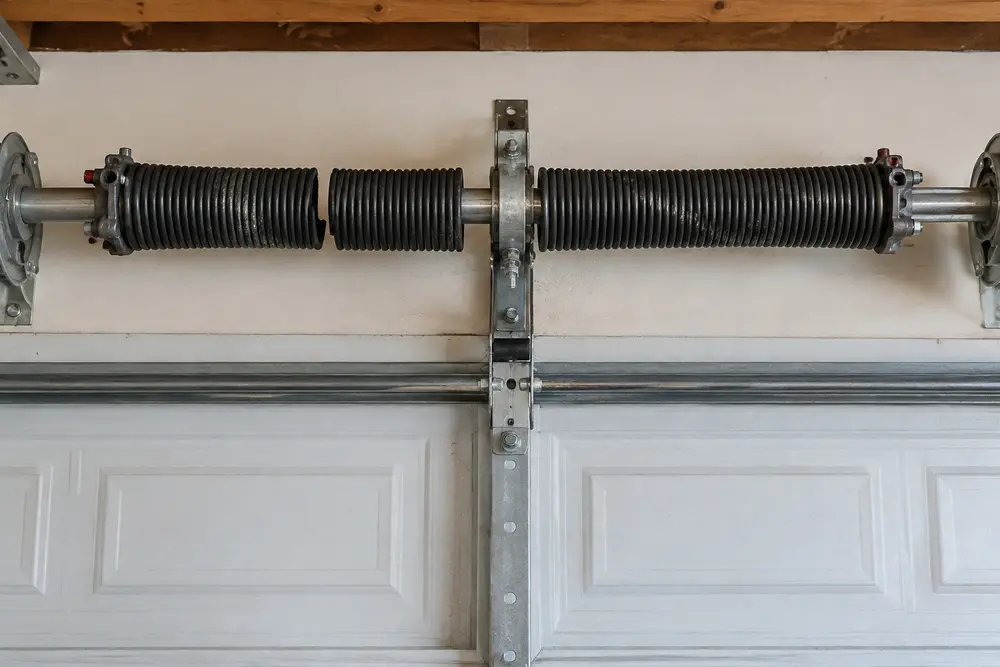
A broken torsion spring commonly shows a clear gap in the coil above the closed door. With extension systems, a spring may hang loose beside the horizontal track or a safety cable may appear displaced.

  • A loud bang came from the garage
  • The opener runs but the door barely moves
  • The door feels far heavier than normal
  • The door rises only a few centimetres and stops
  • One side lifts differently from the other
  • A spring coil has a visible separation

Do not pull, clamp, wind or loosen spring hardware to confirm the diagnosis.

Separated torsion spring above a closed sectional garage door
A visible separation in the torsion coil is a strong indication of spring failure.

Different systems, same safety boundary

Torsion And Extension Springs Work Differently

Torsion Springs

These are typically mounted on a shaft above the door. They twist to create torque and work with drums and lift cables. A break often leaves a visible coil gap.

Extension Springs

These usually run beside the horizontal tracks and stretch as the door closes. Proper safety cables are important because a failed spring can move violently.

Important: The correct replacement depends on door weight, height, track arrangement and hardware—not simply the spring’s appearance.

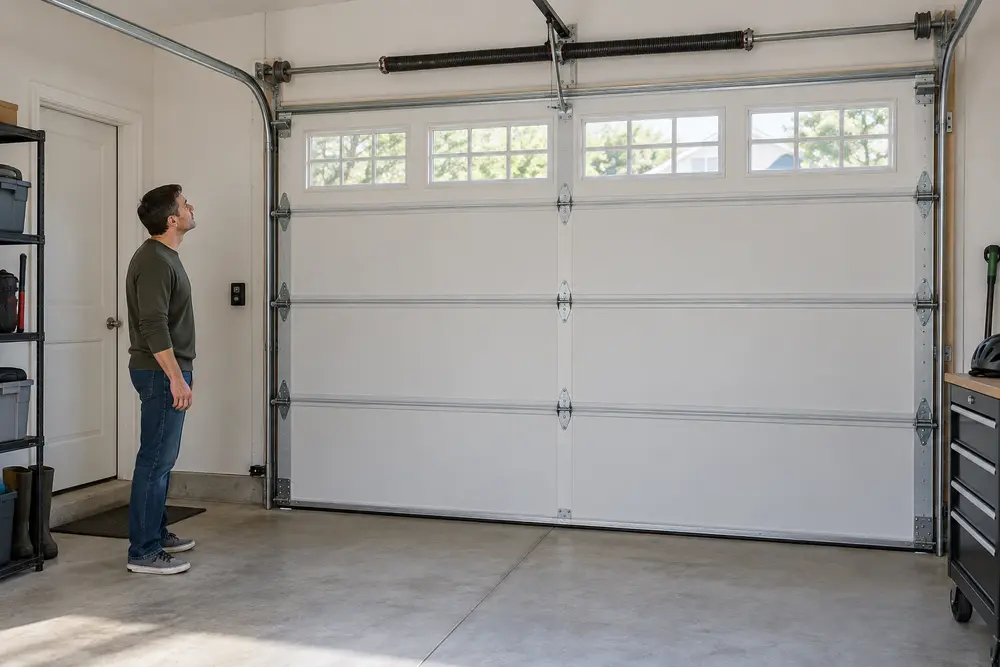
Homeowner observing garage door spring hardware from a safe distance
Observe from a safe position and leave tensioned-hardware testing to a trained technician.

What to do now

How To Respond Safely After A Spring Breaks

  1. Stop using the wall control, remote and smart-app commands.
  2. Keep children, pets and stored items away from the door.
  3. Do not stand beneath a partly open door.
  4. Do not disconnect the opener to test whether you can lift the door alone.
  5. Note the visible symptom and arrange a spring-system inspection.

If the door is crooked as well as heavy, a cable may have lost tension or left its drum. Review the garage door cable repair service rather than forcing the door level.

A complete-system decision

What A Spring Inspection Should Consider

Door Weight And Balance

The replacement must support the actual door, not an assumed standard weight.

Spring Configuration

The technician identifies torsion or extension hardware, spring count and mounting arrangement.

Cables And Drums

Lift cables, drums and attachment points are checked for wear or displacement caused during failure.

Tracks And Rollers

Binding, damage or misalignment can create resistance that affects the complete lifting system.

Opener Condition

The opener is reviewed for strain, but it should not be used to compensate for a heavy or unbalanced door.

Matched Replacement Options

On two-spring systems, both springs’ use and condition should be considered before choosing the scope.

Common questions

Garage Door Spring Questions

What is the most common reason a garage door spring breaks?

Repeated opening and closing cycles gradually fatigue the spring steel. Correct sizing, door balance, installation, environment and maintenance also affect how the system wears.

Can I open a garage door with a broken spring?

Do not keep operating it. The door may be extremely heavy, move unevenly or overload the opener. Keep people clear and arrange an inspection.

Should both springs be replaced together?

On a matched two-spring system, the second spring may have completed a similar number of cycles. A technician should assess both and explain the options for the specific door.

Does cold weather cause garage door springs to break?

Temperature changes can affect metal behaviour and lubrication, but a break usually reflects accumulated fatigue or another system condition rather than temperature alone.

Is garage door spring replacement a DIY repair?

No. Springs, cables, drums and bottom fixtures can store or carry dangerous tension. Spring replacement requires correct parts, procedures and specialized tools.

Spring replacement in Burnaby

Get The Spring System Properly Assessed

Describe the door, the symptom and whether the spring gap is visible. Availability and repair scope are confirmed when you contact us.